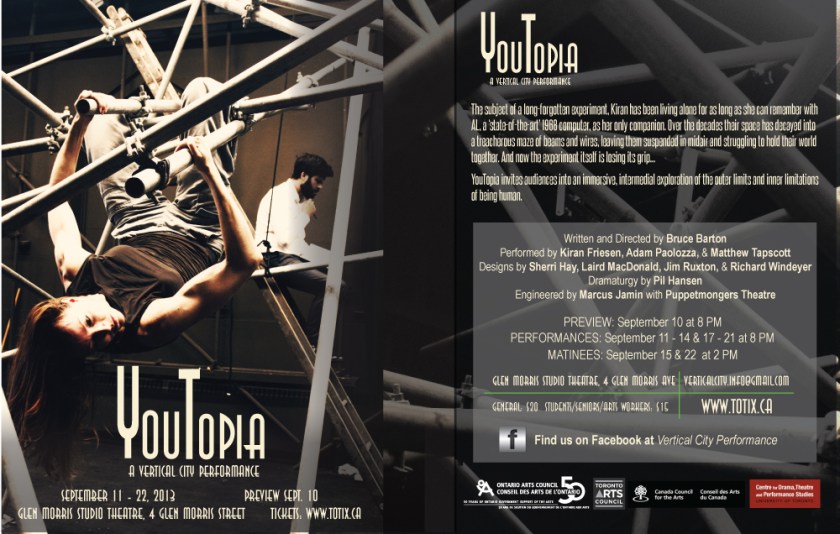
Vertical City’s “YouTopia” Project
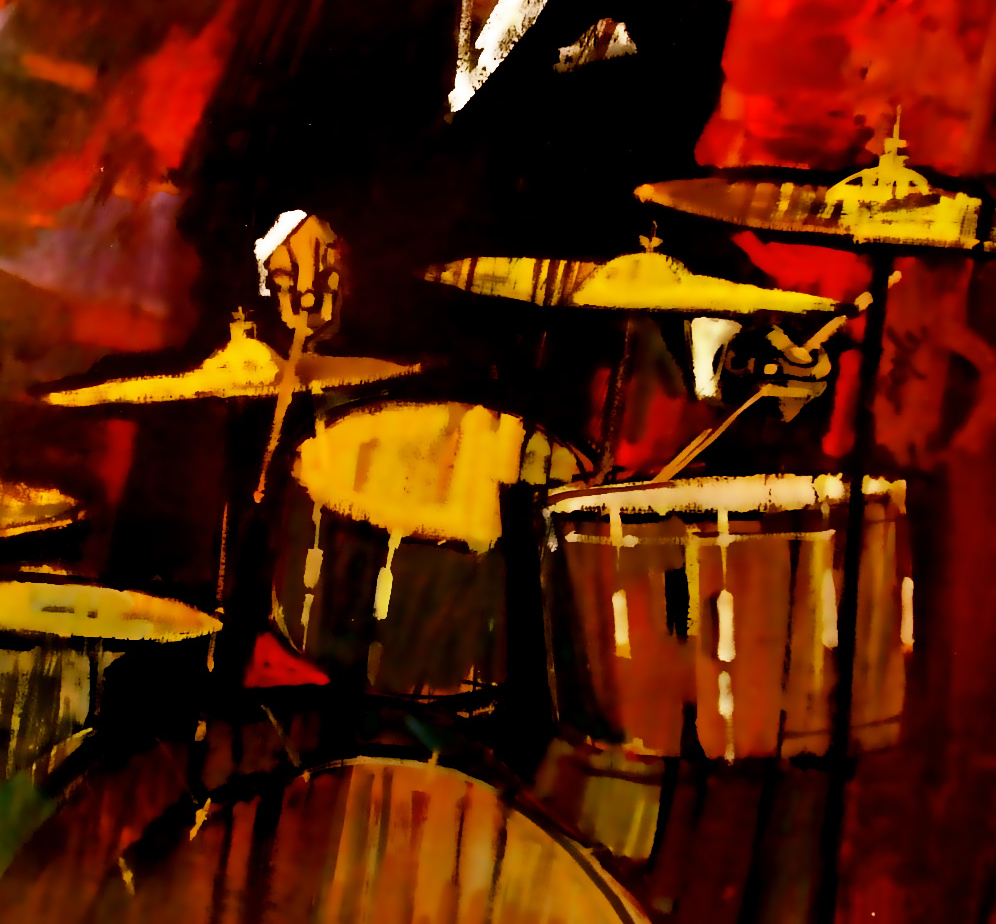
A performance for live percussionist and responsive computer music system this Friday evening (April 19th, 8 pm, $10) at Musideum (Toronto).
This is the latest incarnation of a solo project of mine exploring the physical activity and cultural imagery of the jazz drummer, juxtaposed with the gestural language and technologies of electronic dance music. It looks at how human and machine-made rhythms and systems can most effectively shadow and complement each other, while straddling multiple musical genres (electronic dance music, ambient/soundscape, improvisation, ‘microdubb’, and generative computer music).
Neil Wiernik, a.k.a. NAW and I will be sharing the evening’s festivities. Feel free to drop by and offer discussion or feedback afterwards. Full event details here.
a sound installation for large public spaces
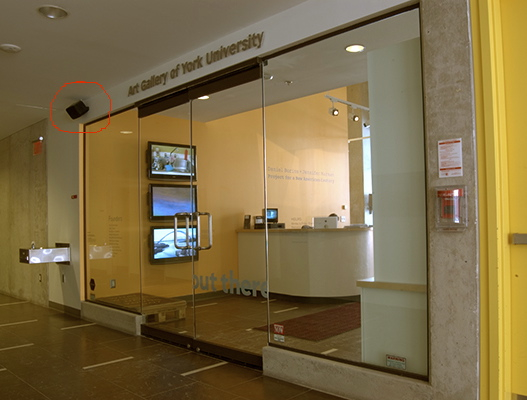
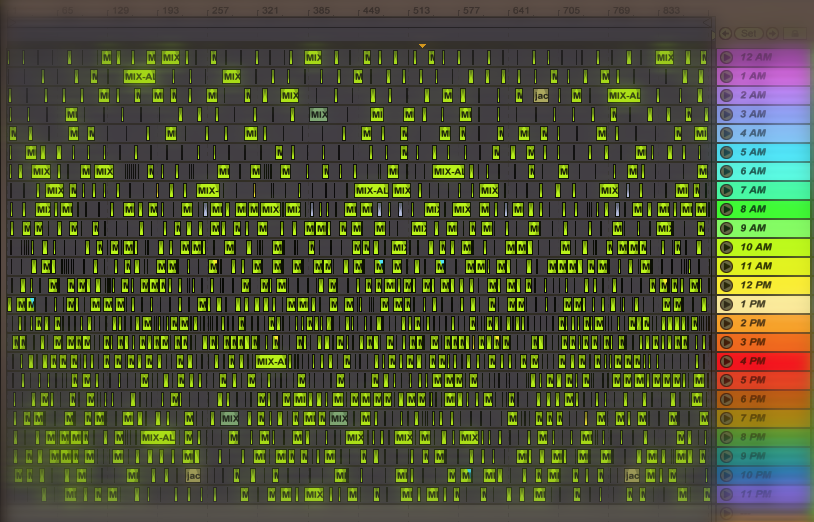
Created for a single audio speaker in a large public space, this audio installation works at framing and punctuating the struggle to control our acoustic surroundings and be heard above the communal din. It consists of twenty-four 1-hour tracks running sequentially in the space at a matching ambient volume level. Like Still(ness) Ringing, this installation also works at blurring the listener’s ability to distinguish between the naturally-occurring sounds in a physical space and programmed or pre-recorded sounds.
Commissioned by Art Gallery of York University’s Audio Out exhibition series
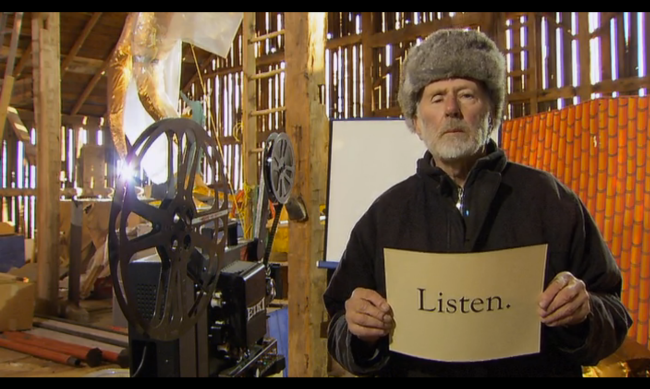
Gallery note: A good shushing (like your grandmother probably used to give you), is like an arrow shot through shared airspace. It pulls focus away from self-obsessed interior gazing and casts it out into the world, framing and punctuating the contribution each of us makes to the collective soundscape of the commons.
A good shushing can also wake you up – if only for a moment – to the struggle that each of us experiences in trying to control our surroundings and be heard above the communal din.
Many elements in this work were first presented as part of (((Cocktail Party Effect))) ‘The Audio Waiters’, a guerrilla performance project, produced and performed in collaboration with InterArts Matrix. Both of these works are available for presentation in other spaces and situations.
©Richard Windeyer 2010
In 1991, while wrapping up my final year of undergraduate studies at Wilfrid Laurier University (and preparing to begin a Masters degree at Simon Fraser University), I was lucky enough to spend a couple hours wandering around campus one afternoon with Canadian composer, environmentalist, author and educator R. Murray Schafer…just the two of us talking about all sorts of things – his music-theatre cycle ‘Patria‘, interdisciplinary work, composition, acoustic ecology and so on…
This past week, while wrapping up duties as a sessional instructor at Wilfrid Laurier University, and preparing to begin Doctoral studies at the University of Toronto (which incidentally will focus heavily on the convergence points between mobile audio technologies, soundscape design, and site-specific performance), I once again found myself spending the better part of a day with Murray. He was in town attending a concert of some of his works for harp and string quartet and had also agreed to appear as a guest speaker in one of my classes.
I couldn’t help but think of how oddly momentous this was for me. Back in 1988, at the beginning of my second year as an undergraduate music composition student, I was completely immersed in Schafer’s book The Tuning of the World. Its effect on me was nothing short of transformative. Not only did it open and inspire my ears , it also changed my ides about what composer could (or should) be in the modern world – an acoustic designer or a soundscape designer – someone who works inter-disciplinarily – like architects and designers and planners – to shape, transform and enrich the sonic environment.
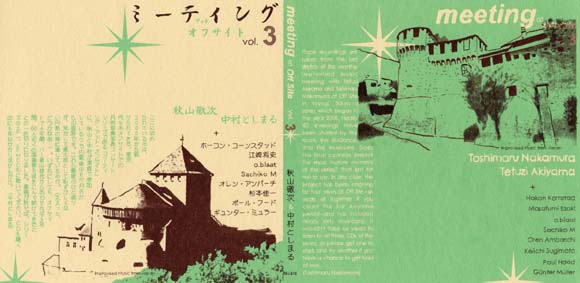
Since this most recent visit with Murray, I’ve been thinking about possible points of convergence between Schafer’s influence (acoustic ecology, soundscape design, etc.) and my own activities as a drummer and live electroacoustics artist. I suppose on the surface, it’s easy to view these things as inherently contradictory and unreconcilable. Yet I started thinking about performances of low-amplitude (‘lowercase’) electronic music which explore and define notions of auditory thresholds, ‘acoustic horizons‘, and – in particular – the Japanese music genre ‘Onkyo‘, as performed in venues such as ‘Off Site‘ several years ago and some specific composers such as Bernhard Günter and others. This is just a start but I’ll try to offer up more thinking around this last idea in the coming weeks, as I prepare for a (rare) drum kit and live electroacoustics performance at Musideum (Toronto) with NAW on April 19th.
Once again, thanks Murray!
 Richard C. Windeyer