Phantom Love (It Comes In Waves) 2015


This marks the first in a series of posts delving into the process of making It Comes In Waves, an immersive theatre production conceived by bluemouth inc., written by Jordan Tannahill with bluemouth inc., directed by Jennifer Tarver, and presented by Necessary Angel, bluemouth inc. and PANAMANIA (presented by CIBC) on Toronto Island as part of the 2015 Toronto Pan Am Games.

With my days as a Toronto Island theatre performer over for the season, I’ve chosen to begin by posting some music created specifically for the show. Phantom Love first emerged from writing by Lucy Simic (bluemouth inc.) and a guitar riff by Stephen O’Connell (bluemouth inc.) — both generated during initial development stages of the show. I fleshed out the music and lyrics, and then recorded and produced the track which was subsequently given some nostalgia-inducing ‘vinyl treatment’. During the performances (in the ‘Fireplace Room’ at the Gibraltar Point Centre for the Arts), the music was diffused through an 8-channel surround-sound playback system placed around the periphery of the room. Playback began through two monitors located directly behind a vintage Califone portable turntable — which incidentally served as a fully-functional prop throughout the show. This effectively (though not entirely precisely) localizes the perceived source of the music, creating an impression that the music is emanating from the record player, until it gradually begins to rotate through the entire speaker system at a speed of 33 rotations per minute. The music accompanies choreography performed by Stephen and Lucy, which also travels around the room.

Califone prop

It comes in waves

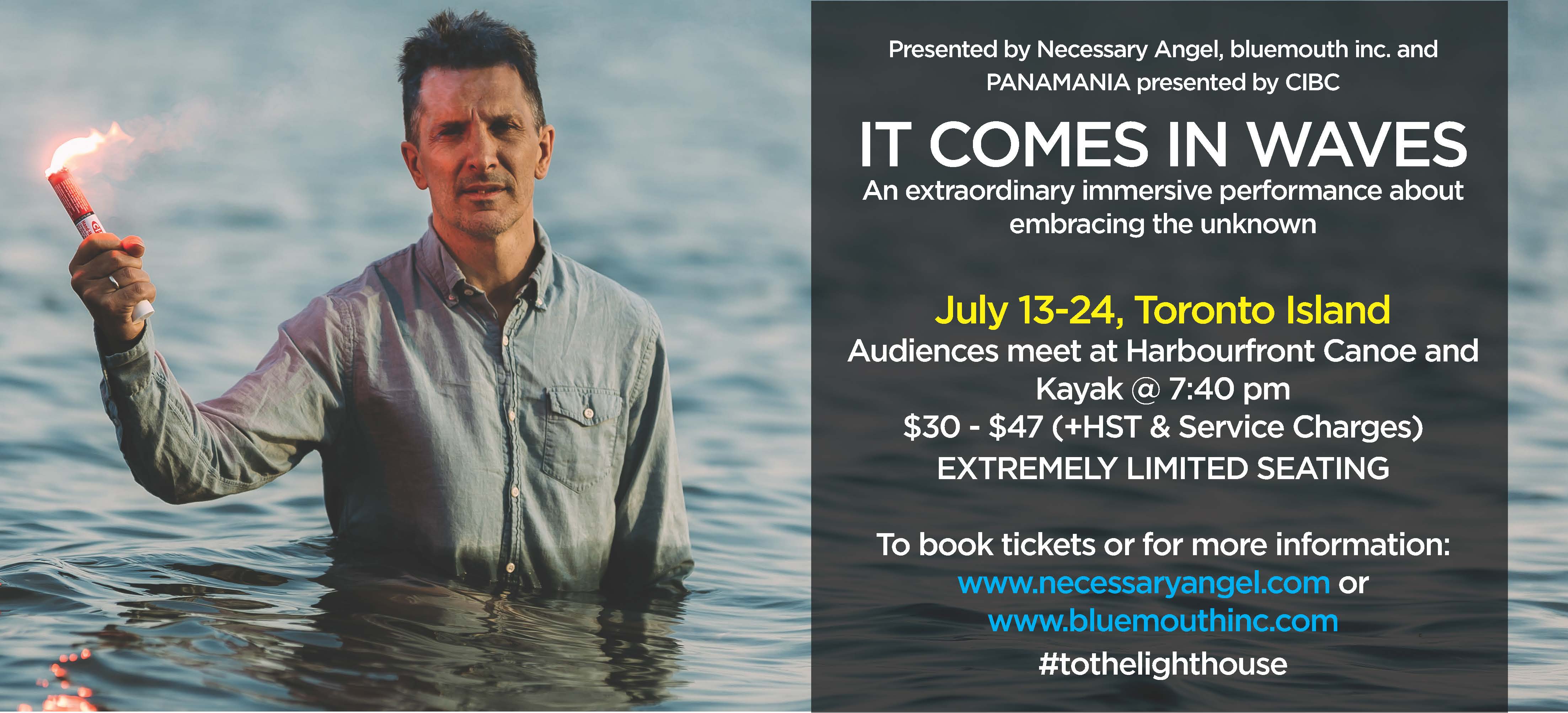
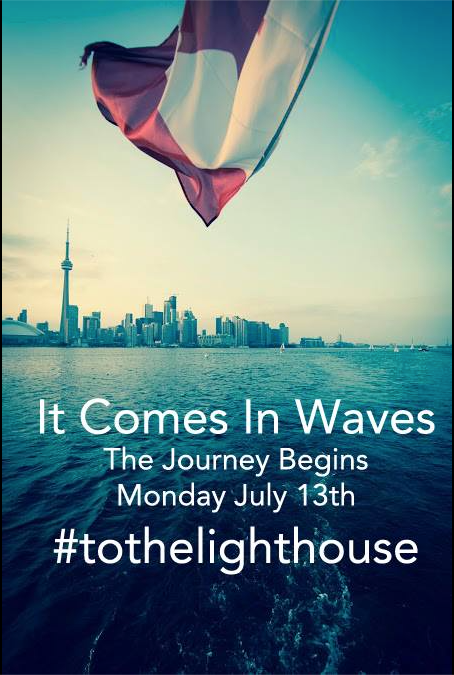
iCiW_promoAs some of you may know, I’m currently working on a new and rather uniquely immersive performance experience on Toronto Island entitled It Comes In Waves (produced by bluemouth inc and Necessary Angel).

Over the course of the evening, audiences canoe to Toronto Island, throw a surprise party, sing a few songs, play a round of strip poker, and help prepare a man for the greatest journey of his life. It’s the kind of theatrical experience which, for the moment, I can only really describe as “…if Frederico Fellini had made an Elvis movie”.

We’re in the last few days of rehearsals now. I will be updating this  post in the coming weeks, looking at several aspects of sound, interaction and dramaturgical design as they’ve unfolded in this new work.

Until then…


It Comes in Waves promocard

The Digital Voice Lab in Paris

Bodies On Stage: Acting Confronting Technologies conferenceAs June busts out across the European Union, I have just joined fellow Digital Dramaturgy Lab member Sebastian Samur in a hot and humid Paris, France to co-present a paper at the Bodies On Stage: Acting Confronting Technologies conference held at the Université Sorbonne Nouvelle Paris 3. Our presentation — Moi qui parle à moi-même dans le numérique / Auditory Alienation and Liberation for the Intermedial Performer — documents the results of our recent Digital Voice Lab experiments — a component of Sebastian’s ongoing Voice Exchange forum at The Centre For Drama, Theatre and Performance Studies (University of Toronto), in which we explored the creative and dramaturgical potential of actors working with electronic voice modulation (a.k.a. ‘voice mask’) tools — such as pitch-shifting and time delay —to develop new characters or (alternatively) new approaches to performing well-known characters, such as Shakespeare’s Hamlet.

Here is Sebastian explaining our digital ‘voice mask’ research (in French) during a conference break.

Speed, meditation, time & technology

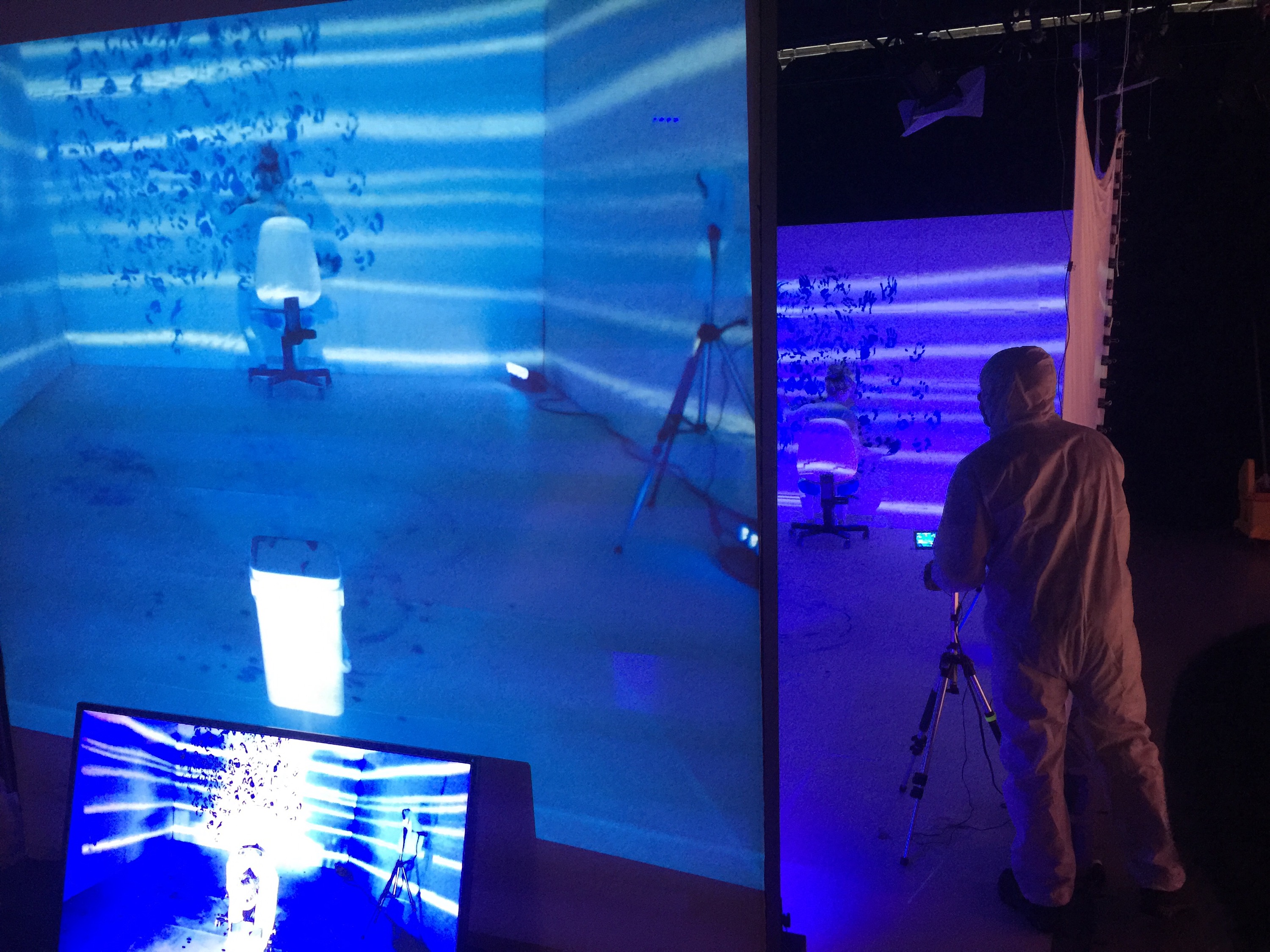
As rumours begin to spread about the approach of summer, the University of Toronto’s Digital Dramaturgy Lab (DDL) has been presenting Stare. Print. Blue. (Voyeuring the apparatus)a durational and intermedial performance environment — over three days in the ‘Pleasure Room’ at Digifest Toronto 2015. Stare. Print. Blue. is a meditative provocation of slowness in an age of rapidly intensifying acceleration. As an immersive and technologically mediated environment, it seeks to challenge the endurance capabilities of a single performer by forcing concentration on absolute slowness of movement, while focusing the viewer’s attention on experiences of time as mediated by and through digital technology. 

My soundscape design focused specifically on creating an immersive and meditative listening space with a dual function — first, as means of encouraging a meditative experiencing of ‘slowness’ within viewer perception, and second, as a audio-temporal framework capable of helping the solo performer maintain both the slow pacing of their physical movements and their mental focus for the duration of their experience within the installation space.

The ‘DDL@Digifest’ collaborative team includes Antje Budde, Nazli Ahktari, Monty Martin, Michael Reinhart, William J Mackwood, Karyn McCallum, Alfred Renaud, Don Sinclair, and (myself) Richard Windeyer.

2YouTopia / Vertical City @ Nuit Blanche Toronto 2014

Hulaboom binaural

For best results, listen on headphones. In this demonstration:

• The audio signal is fed through digital processing software via binaural microphones worn by the drummer. This enables the drummer to influence the mix of acoustic kit instruments to be processed – including the degree of sonic detail and relative strength of the signal as it enters the processing chains – by adjusting their physical proximity to the kit (i.e., head related transfer functions).

• A collection of household ‘foley’ sounds (stored in a granular synthesis engine) are activated by an acoustic MIDI trigger mounted on the kick drum. This offers the possibility of using drum velocity values to trigger looped and often unmetered textures which the drummer can then play in counterpoint with.

• The current ‘soundscape’ of this kit borrows from traditional ‘dub’ processing techniques (echo, feedback, band-pass filters coupled with envelope followers, ‘spring’ reverbs), yet also attempts to infuse each instance of a dub echo with different sonic information, such as discreet ‘foley’ sounds, voices or harmonic ‘augmentations’ generated by a vocoder.

• Gated ‘ghost tracks’ are also revealed through changes in the drummer’s loudness levels. In this demonstration, the ‘ghost track’ is an archival interview recording of early jazz drummer Warren ‘Baby’ Dodds for the Folkways album “Baby Dodds – Talking And Drum Solos” (Folkways Records – FJ 2290, 1951)

Hulaboom

sandyoilkit

Hulaboom is an ongoing-series of original studio releases and instrument design experiments begun in 2014. Each track begins as an improvisation on a ‘hybridized’ (electroacoustic) drum kit, through which a variety of signal processes, samples and gated ‘ghost tracks’ are activated by the drummer.

In this initial phase of development, the compositional structure and sonic palette of each improvisation is expanded and shaped by studio production methods.

Subsequent phases of development will focus on:

  • multichannel (surround-sound) diffusion of the electroacoustic material
  • increased emphasis on improvised performer interactions with generative music systems (rather than entirely pre-composed content).
  • integration of movement/body tracking data as a compositional determinant
  • integration of triggered/controlled digital video as both image and light source
  • amplification of the drum kit using binaural microphones (worn by the drummer)
  • explorations of the drummer as cultural icon and storyteller.
    (September 2014)

Practice-as-Research in the Arts

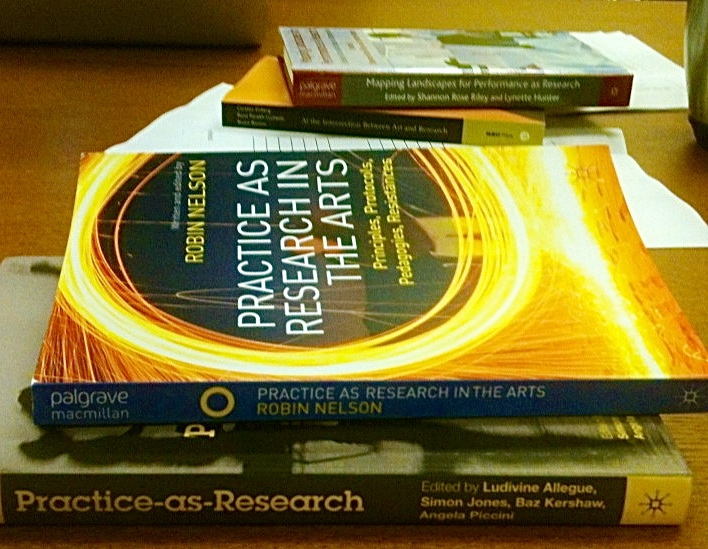
Practice-as-research book piles
Week 4, year 1 of doctoral studies. You will know me by my piles of books!